
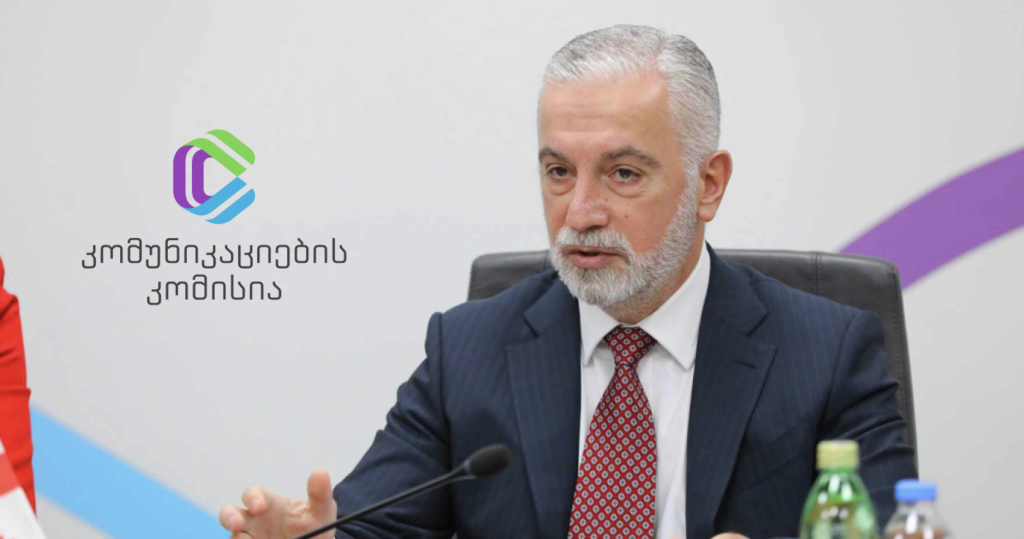
Kakha Bekauri’s 12-year term at the Communications Commission has come to an end, an institution he led for years and which, during his tenure, was used as a repressive instrument against independent media. The Commission’s punitive actions were neither isolated nor spontaneous. Under Bekauri’s formal control, the regulator, for years, adopted selective and targeted decisions against independent media outlets.
Before joining the Communications Commission, Kakha Bekauri had many years of experience in the media sector. He headed several broadcasters, including serving as director of Channel 9, owned by the family of Bidzina Ivanishvili. Bekauri became a member of the Commission in 2014 and assumed the position of Chair in 2017. Numerous legitimate questions were raised regarding his professional qualifications, casting a serious shadow over the legitimacy of his leadership. In 2019, before Bekauri was reappointed as a member of the Commission for a second term, a controversial amendment was introduced to the Law on Broadcasting, abolishing the prohibition on electing the same commissioner as Chair for more than one term. The amendment was widely criticized and raised legitimate suspicions that the law had been tailored specifically for Kakha Bekauri.
During Bekauri’s leadership, the Commission’s repressive practices became the subject of sharp criticism from numerous local and international organizations. The regulator radically changed its approach to the regulation of political advertising and, contrary to established practice, began fining media outlets for airing political advertisements outside the official election period. During the 2024 pre-election period, critical broadcasters were sanctioned for refusing to air advertising videos of the Georgian Dream party. According to multiple assessments, these advertisements contained manipulative, unethical, and hate-filled messages, including the speculative use of the tragedy of the Ukrainian people for electoral purposes. Despite this, the Commission rejected the broadcasters’ arguments. The advertisements were also condemned by the European Parliament.
With Bekauri’s active involvement, the Commission also attempted to restrict public opinion polling. The regulator sent letters to broadcasters demanding that they “verify the reliability” of surveys and threatening sanctions. These actions were widely assessed as an attempt to effectively ban polls and to impose pre-election self-censorship.
In a decision concerning one of the programs of the television company Mtavari Arkhi, the Commission classified the content of a segment as indecent and effectively assumed the authority to assess editorial content. This decision sent a clear signal that the Commission was prepared to take on a content control function, although such assessments fall within the competence of self-regulatory mechanisms or the courts. In 2021, this practice was reinforced by Bekauri’s public statements calling for additional regulation of the media, which, in a polarized media environment, were perceived not as neutral analysis but as institutional distrust toward critical media.
In 2025, by upholding a complaint filed by Georgian Dream with the Communications Commission, Bidzina Ivanishvili’s party sought to prohibit the media from using specific terms. In this case, the Commission did not act as a neutral arbiter but rather as a body advancing the interests of Georgian Dream.
The systematic support of repression against independent media led to Kakha Bekauri being sanctioned by Lithuania and Ukraine as an individual who actively participated in restricting media freedom and in turning the regulator into a political instrument. In February 2025, the European Parliament adopted a resolution on Georgia calling for sanctions against elites associated with Georgian Dream, including Bekauri.
The selection process for the position of commissioner within the regulator was effectively closed to external, independent candidates. For years, the process was largely formal and favored incumbent commissioners and staff-particularly individuals under Bekauri’s influence or those loyal to him. This further weakened the institution’s professional independence and strengthened the Chair’s personal influence within the Commission.
During his time at the Commission, Kakha Bekauri’s financial situation improved significantly. Alongside his highly paid public office, he is a co-owner of the “Ori Nabiji” supermarket chain, which generates millions of GEL in income for him.
Kakha Bekauri’s legacy at the National Communications Commission is not associated with the creation of a stable, free, and trust-based environment for the media. During his chairmanship, the Commission evolved into a politically biased institution whose activity was particularly evident in advancing the interests of Georgian Dream. The Commission failed to strengthen institutionally-in terms of independence, professional authority, or public trust-because its influence relied largely on the power to sanction and selective enforcement rather than on consistent, transparent, and fair regulation.